The Headroom Already Spent: How 2026's Borrowing Calendar Preloads 2027's Ceiling Fight
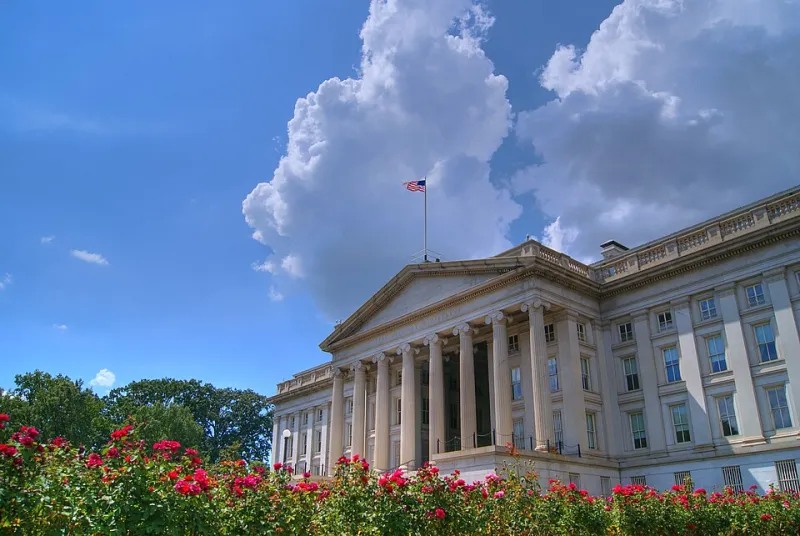
Photo: Erich Robert Joli Weber, CC BY-SA 3.0, via Wikimedia Commons
Treasury's quarterly borrowing estimates rarely make front pages. But the late-2026 editions carry a particular kind of political information: they tell Congress how much room it will have, and how little time, when the next debt-limit confrontation begins. The numbers are not a forecast of default. They are a schedule of constraints.
That schedule matters because the debt ceiling is not a single event. It is a sequence of accounting decisions, financing auctions, and legislative deadlines. By the time the 120th Congress convenes in January 2027, much of the runway will already have been measured. The December funding patch will have set spending levels for part of the fiscal year. Treasury will have described its cash balance and its borrowing needs. And the first votes of the new Congress will determine whether the ceiling is handled as a routine housekeeping measure or converted into a bargaining chip.
The X-Date Is a Range, Not a Day
Officials and analysts often speak of the X-date as if it were a fixed point on the calendar. It is better understood as a range. The government can continue to meet its obligations only as long as cash on hand and incoming receipts cover outgoing payments. Those flows are uneven. Tax receipts arrive in bursts. Benefit payments, vendor invoices, interest costs, and payroll obligations do not arrive on a single schedule. Treasury can manage the timing at the margins, but it cannot make the underlying arithmetic disappear.
That is why the late-2026 borrowing estimates are politically significant. They do not merely project how much Treasury will need to borrow in the coming quarter. They also indicate how much headroom the department expects to have before it must begin using extraordinary measures. If borrowing needs rise faster than receipts, the window narrows. If receipts arrive more slowly than expected, the window narrows again. The X-date can move by weeks based on events that have nothing to do with a floor vote in the House or a cloture motion in the Senate.
For Congress, the practical consequence is that the next debt-limit fight will begin with less flexibility than the previous one. A new member may arrive in January expecting a fresh start. Treasury's calendar will not offer one.
The Extraordinary-Measures Playbook, Read as a Calendar
The extraordinary-measures playbook is well established, even if it is frequently described in shorthand. When the government approaches the statutory limit, Treasury can suspend reinvestment in certain retirement and trust funds, redeem or suspend securities, and use other accounting mechanisms to create temporary room. These steps do not create new borrowing authority. They buy time.
The sequence matters. Treasury typically turns first to funds whose suspension is least disruptive to current beneficiaries, including the Civil Service Retirement and Disability Fund and the Thrift Savings Plan's G Fund. It may also use the Exchange Stabilization Fund. Each step is reversible once the limit is raised or suspended, but each step also carries a political message: the department is managing a legal constraint, not a lack of resources.
That message is often lost in the debate. The extraordinary measures are not a secret reserve. They are a bridge. The length of that bridge depends on the size of the monthly deficit, the pace of receipts, and the willingness of financial markets to absorb new debt once the limit is lifted. The late-2026 borrowing estimates give Congress an early reading of how long the bridge is likely to be.
December's Patch Is a Down Payment on the Timeline
The December funding patch is usually discussed as a spending story. It is also a debt-limit story. A stopgap that extends current spending levels reduces the immediate risk of a shutdown, but it does not reduce the underlying cash demands. It simply moves the next appropriations deadline into 2027. That new deadline will sit close to the period when Treasury's borrowing capacity is most constrained.
This is where the two calendars intersect. If the stopgap expires in early 2027, Congress will face a must-pass spending bill at roughly the same time Treasury is managing the approach to the debt limit. The sequencing creates leverage for anyone who wants to attach ceiling language to a spending vehicle. It also creates risk for anyone who wants a clean increase. A must-pass bill can carry a debt-limit suspension, but it can also become the hostage of unrelated disputes.
The December patch does not determine which outcome will prevail. It determines when the choice becomes unavoidable.
Three Votes That Will Define 2027
The first test will not be a vote on the debt limit itself. It will be a procedural vote on the vehicle that carries it. In the House, the rule governing debate will reveal whether leadership intends to protect a clean suspension or allow amendments that tie the ceiling to spending cuts, policy riders, or unrelated priorities. A restrictive rule points toward a negotiated package. An open or modified rule points toward a longer fight.
The second test will be Senate cloture. A clean debt-limit increase or suspension must clear the 60-vote threshold unless it is attached to a reconciliation bill or another privileged vehicle. The cloture vote will show whether a bipartisan coalition can hold together for a straightforward measure or whether the ceiling becomes a partisan proxy. The margin, and the number of members who choose not to vote, will matter as much as the outcome.
The third test will be the first motion to concur or conference report on an appropriations package after the December patch expires. That vote will show whether Congress treats the debt limit as a separate obligation or folds it into the spending fight. If the ceiling language is stripped out and sent to a standalone bill, the clean-raise path remains open. If it is retained in the appropriations vehicle, the ceiling becomes part of the broader budget negotiation.
What a Clean Raise Would Look Like
A clean raise does not require a dramatic moment. It requires a legislative slot. In practice, that means a bill reported by the relevant committee, a rule that allows a vote, and a Senate process that does not require a supermajority to proceed. It also means Treasury has enough headroom to avoid a binding X-date before the bill reaches the president's desk.
The late-2026 borrowing estimates do not guarantee that any of those conditions will be met. They simply narrow the margin for error. The December patch does not settle the fight. It sets the starting line.
For the 120th Congress, the debt ceiling will arrive as an inherited calendar problem before it becomes a discretionary political choice. The first three votes of 2027 will show whether members treat that inheritance as a reason for a clean raise or as an opportunity to extract concessions. Treasury's numbers will not make that decision. They will only mark how little time remains to make it.